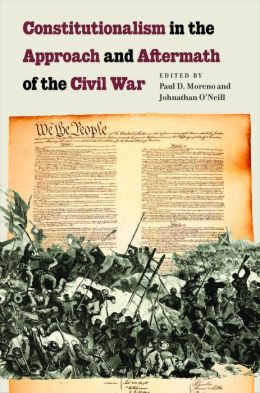
More information is available here.The irreducibly constitutional nature of the Civil War’s prelude and legacy is the focus of this absorbing collection of nine essays by a diversity of political theorists and historians. The contributors examine key constitutional developments leading up to the war, the crucial role of Abraham Lincoln’s statesmanship, and how the constitutional aspects of the war and Reconstruction endured in the late nineteenth and early twentieth centuries. This thoughtful, informative volume covers a wide range of topics: from George Washington’s conception of the Union and his fears for its future to Martin Van Buren’s state-centered, anti-secessionist federalism; from Lincoln’s approach to citizenship for African Americans to Woodrow Wilson’s attempt to appropriate Lincoln for the goals of Progressivism. Each essay zeroes in on the constitutional causes or consequences of the war and emphasizes how constitutional principles shape political activity. Accordingly, important figures, disputes, and judicial decisions are placed within the broader context of the constitutional system to explain how ideas and institutions, independently and in dialogue with the courts, have oriented political action and shaped events over time.
Thursday, September 19, 2013
New Release: "Constitutionalism in the Approach and Aftermath of the Civil War"
New from Fordham University Press: Constitutionalism in the Approach and Aftermath of the Civil War, edited by Paul D. Moreno (Hillsdale College) and Johnathan O'Neill (Georgia Southern University). The Press describes the book as follows:

Wednesday, September 18, 2013
New Release: Flaherty, "Public Law, Private Practice: Politics, Profit, and the Legal Profession in Nineteenth-Century Japan"
The Harvard University Asia Center has released Public Law, Private Practice: Politics, Profit, and the Legal Profession in Nineteenth-Century Japan (2013), by Darryl E. Flaherty (University of Delaware). A description from the publisher:
Long ignored by historians and repudiated in their time, practitioners of private law opened the way toward Japan’s legal modernity. From the seventeenth to the turn of the twentieth century, lawyers and their predecessors changed society in ways that first samurai and then the state could not. During the Edo period (1600–1868), they worked from the shadows to bend the shogun’s law to suit the market needs of merchants and the justice concerns of peasants. Over the course of the nineteenth century, legal practitioners changed law from a tool for rule into a new epistemology and laid the foundation for parliamentary politics during the Meiji era (1868–1912).

This social and political history argues that legal modernity sprouted from indigenous roots and helped delineate a budding nation’s public and private spheres. Tracing the transition of law regimes from Edo to Meiji, Darryl E. Flaherty shows how the legal profession emerged as a force for change in modern Japan and highlights its lasting contributions in founding private universities, political parties, and a national association of lawyers that contributed to legal reform during the twentieth century.
Friedman's Introduction to "Law and the Modern Condition"
Lawrence Friedman, New England Law, has posted the Introduction to Law and the Modern Condition: Literary and Historical Perspectives, ed. Lawrence Friedman (Talbot Publishers, 2013). Here is the abstract:
Using fiction as a lens through which to view particular developments in the law, each of the essays in the new book, Law and the Modern Condition: Literary and Historical Perspectives (Talbot Publishing, 2013), discusses a work of literary fiction — some classical (the tale of Ruth in the Bible, the fiction of Franz Kafka and Herman Melville, the plays of William Shakespeare) some modern (the post-September 11 fiction of William Gibson, Ken Kalfus, Claire Messud, Ian McEwan and Helen Schulman) — that concerns, directly or indirectly, the historical development of the law. This exploration of legal history through fiction pays particular attention to its relevance to our present circumstances and our growing concerns about terrorism and civil liberties. Each essay considers the legal lessons about the fictional event or events at its core, lessons that tell us something worth remembering as we continue to chart law’s evolution. These lessons, like those that may be found in all great literature, necessarily extend beyond the historical confines of the characters and plot and background of each story to embrace the modern condition — which, as these great stories suggest, is and always has been the only condition.
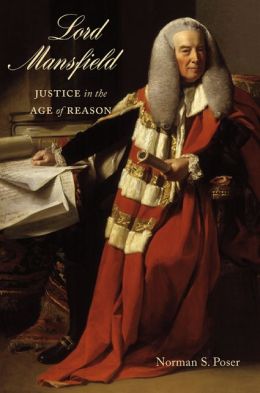
New Release: Poser, "Lord Mansfield: Justice in the Age of Reason"
New from McGill-Queen's University Press: Norman S. Poser, Lord Mansfield: Justice in the Age of Reason (2013). Poser is professor emeritus at Brooklyn Law School. A description from the publisher:
A few blurbs:In the first modern biography of Lord Mansfield (1705-1793), Norman Poser details the turbulent political life of eighteenth-century Britain's most powerful judge, serving as chief justice for an unprecedented thirty-two years. His legal decisions launched England on the path to abolishing slavery and the slave trade, modernized commercial law in ways that helped establish Britain as the world's leading industrial and trading nation, and his vigorous opposition to the American colonists stoked Revolutionary fires. Although his father and brother were Jacobite rebels loyal to the deposed King James II, Mansfield was able to rise through English society to become a member of its ruling aristocracy and a confidential advisor to two kings. Poser sets Mansfield's rulings in historical context while delving into Mansfield's circle, which included poets (Alexander Pope described him as "his country's pride"), artists, actors, clergymen, noblemen and women, and politicians. Still celebrated for his application of common sense and moral values to the formal and complicated English common law system, Mansfield brought a practical and humanistic approach to the law. His decisions continue to influence the legal systems of Canada, Britain, and the United States to an extent unmatched by any judge of the past. An illuminating account of one of the greatest legal minds, Lord Mansfield presents a vibrant look at Britain's Age of Reason through one of its central figures.
"I read this book with much pleasure and instruction. It admirably fills a major gap in the body of legal historical literature - the absence of a comprehensive biography of arguably the most famous and influential Anglo-American judge of the modern era." -- Simon Devereaux"A remarkable portrait of both a man and a legal age. I enjoyed the book tremendously, learned so much, and am deeply grateful. A master work." -- Kent Syverud
Rabb to Harvard Law School
Harvard Law School has announced that legal historian Intisar Rabb will join the faculty in 2014. From the HLS press release:
Congratulations to Intisar Rabb and to Harvard Law School!
Intisar A. Rabb, a leading expert on Islamic Law and legal history, will join the faculty of Harvard Law School beginning Spring 2014, with an appointment as a tenured Professor of Law.
Intisar A. Rabb (credit)

Rabb is currently associate professor of Middle Eastern and Islamic Studies and Law at New York University School of Law, where she holds a joint appointment at the NYU Middle Eastern and Islamic Studies Department and the NYU School of Law. At HLS, she will be a faculty director of the Islamic Legal Studies Program.Read on here.
Congratulations to Intisar Rabb and to Harvard Law School!
Tuesday, September 17, 2013
Policy History Plenaries Announced
The Institute for Political History and the Journal of Policy History are drumming up interest in next June’s Conference on Policy History by circulating news of three plenary sessions:
Wednesday June 4: “Party Balance, Partisan Polarization, and Policy Conflict,” with Michael Holt, Daniel Walker Howe, Richard John, Gareth Davies, Sidney Milkis, Byron Shafer
Thursday June 5: “Can Social Activism Change Public Policy? If so, How? If not, Why Not?” with Mark Brilliant, Rhonda Williams, Nancy MacLean, Matthew Garcia
Friday, June 6: “New Perspectives on the Presidency and Party Politics,” with Jeffrey Pasley, Mark Summers, Irwin Gellman, Bruce Miroff, Daniel DiSalvo
The conference–the eighth biennial– will take place at the Sheraton Capitol Square Hotel in downtown Columbus, Ohio from June 4-7, 2014. The organizers report:
Wednesday June 4: “Party Balance, Partisan Polarization, and Policy Conflict,” with Michael Holt, Daniel Walker Howe, Richard John, Gareth Davies, Sidney Milkis, Byron Shafer
Thursday June 5: “Can Social Activism Change Public Policy? If so, How? If not, Why Not?” with Mark Brilliant, Rhonda Williams, Nancy MacLean, Matthew Garcia
Friday, June 6: “New Perspectives on the Presidency and Party Politics,” with Jeffrey Pasley, Mark Summers, Irwin Gellman, Bruce Miroff, Daniel DiSalvo
The conference–the eighth biennial– will take place at the Sheraton Capitol Square Hotel in downtown Columbus, Ohio from June 4-7, 2014. The organizers report:
We are currently accepting panel and paper proposals on all topics regarding American political and policy history, political development, and comparative historical analysis. Complete sessions, including two or three presenters with chair/commentator(s) are strongly encouraged. Individual paper proposals are welcome. Because the conference has grown in size, individual papers might have a more difficult time being placed on the program. In order to accommodate more participants, conference organizers have created a poster session which will allow younger scholars to display their research projects. Participants may only appear once as a presenter in the program.Proposals for posters, panels and papers must be submitted online here. Deadline for submission is December 2, 2013.
An Author's Query
Mark J. Osiel, University of Iowa College of Law, asks:
I wonder whether anyone might be able to suggest examples of situations, in various countries, where the law is considerably more indulgent toward a given practice than prevailing views within society at large, because law-makers assume that conventional morality will dissuade people from “abusing” their legal rights, exercising them in what most people consider “irresponsible” ways. For instance, U.S. law tolerates a great deal more in hate speech than any other Western society; but then we’ve never suffered the Third Reich.Please respond directly to Professor Osiel.
Subscribe to:
Posts (Atom)