There have been three print editions since 1989 of Honorable Justice: The Life of Oliver Wendell Holmes by Sheldon Novick: the first hardcover edition from Little Brown, a trade paperback edition from Dell Publishing, and a collectible leather-bound edition from Legal Classics Library. The text of successive print editions was unchanged. A new ebook edition from Plunkett Lake Press has been revised and corrected, redesigned for digital readers, and a new preface has been added bringing the book up to date. This article includes the text of the preface.
In summary: Interest in Justice Holmes continues, especially with regard to his First Amendment jurisprudence. He has also become a major figure in debates over originalism. As portrayed in this biography, Holmes was a champion of the common law, particularly as common-law privileges were the basis of the Bill of Rights. He viewed the Supreme Court as a common-law court bound by its precedents, and engaged in the process of defining the principles "transplanted from foreign soil" found in those precedents The New Originalists argue that the original understanding of the text of the Constitution is authoritative in cases arising under the Constitution, and that fidelity to the original understanding trumps any precedents that depart from it. Holmes, the champion of an evolving common law, accordingly has become the target of originalist criticism, criticism that the author of this preface claims he stoutly withstands.
Showing posts with label Constitutional studies. Show all posts
Showing posts with label Constitutional studies. Show all posts
Friday, September 20, 2013
Novick on Holmes and the New Originalists
Sheldon Novick, Vermont Law School, has posted a new preface, entitled Honorable Justice at Twenty-Five, to his biography Honorable Justice: The Life of Oliver Wendell Holmes (1989). Here is the abstract:

Thursday, September 19, 2013
New Release: Enayat, "Law, State, and Society in Modern Iran"
Palgrave Macmillan has released Law, State, and Society in Modern Iran: Constitutionalism, Autocracy, and Legal Reform, 1906-1941, by Hadi Enayat. The publisher describes the book as follows:
A few blurbs:Incorporating history, sociology, and rule of law studies, this book sheds light on an understudied but fascinating dimension of modernization in Iran, namely the emergence of a new legal system between the 1906 Constitutional Revolution and the end of Reza Shah's rule in 1941. While Iranian constitutionalism can be seen as part of a global trend of constitutional revolutions at the turn of the twentieth century, in Iran, an unusual institutional and historical background shaped a path to legal reform that was in many ways unique. Among other factors, the scholastic legalism of the Shi'i ulama and the considerable autonomy they enjoyed in administering the civil law in the nineteenth century made legal reform a particularly contested, difficult, and politically charged aspect of state building.

"Law, State, and Society in Modern Iran offers a perceptive examination of the impact of legal reforms on the process of state building and modernization in the first half of twentieth century in Iran. Its use of a wide range of primary source material will be particularly welcomed by historians of the period, and its broad analytical approach should make it indispensable for comparative studies of legal reforms in the wider context of the Middle East and current debates on constitutional development." -- Ali Gheissari
"Legal transformations of codes, institutions, and procedures constituted a crucial motor in the formation of political modernity and the modern state in Iran. This book contains lucid and original accounts and analyses of the events and processes in these transformations, rich in the details of political struggles and ideological contests, not only between the entrenched clerical hierarchy and the modernizing constitutionalists but also within and across both camps. This is key to understanding the subsequent fractured evolution of Iranian state, society, and revolution." -- Sami Zubaida
Cushman on "Court-Packing and Compromise"
 |
| Senate Judiciary Committee Considers the Court-Packing Bill (Credit: LC) |
President Franklin D. Roosevelt’s 1937 Court-packing bill would have permitted him to appoint six additional justices to the Supreme Court, thereby expanding its membership to fifteen immediately. Throughout the ultimately unsuccessful campaign to enact the measure, Roosevelt was presented with numerous opportunities to compromise for a measure authorizing the appointment of fewer additional justices. The President rejected each of these proposals, and his refusal to compromise often has been attributed to stubbornness, overconfidence, or hubris. Yet an examination of the papers of Attorney General Homer S. Cummings reveals why FDR and his advisors believed that he required no fewer than six additional appointments in order to secure a liberal working majority on the Court. Those sources also help to clarify why the substitute Court bill introduced by Senate Majority Leader Joseph Robinson in July of 1937 took the form that it did, and why Robinson’s untimely death that month not only made passage of the bill impossible, but also made it unnecessary. Though Roosevelt’s refusal to compromise can be seen as more rational than is commonly thought, in retrospect one can see that his Court-packing proposal was an entirely unnecessary misadventure through which the President ultimately lost far more than he gained.Update
I can't resist the temptation to chime in with something I've just read in the archives. On November 4, 1936, Charles E. Wyzanski, Jr., wrote his mother from the Solicitor General's office: “I do not like the size of the Roosevelt vote. With a man of the President’s temperament such an endorsement may prove an irresistible temptation." DRE.
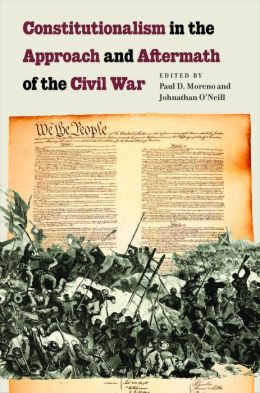
New Release: "Constitutionalism in the Approach and Aftermath of the Civil War"
New from Fordham University Press: Constitutionalism in the Approach and Aftermath of the Civil War, edited by Paul D. Moreno (Hillsdale College) and Johnathan O'Neill (Georgia Southern University). The Press describes the book as follows:
More information is available here.The irreducibly constitutional nature of the Civil War’s prelude and legacy is the focus of this absorbing collection of nine essays by a diversity of political theorists and historians. The contributors examine key constitutional developments leading up to the war, the crucial role of Abraham Lincoln’s statesmanship, and how the constitutional aspects of the war and Reconstruction endured in the late nineteenth and early twentieth centuries. This thoughtful, informative volume covers a wide range of topics: from George Washington’s conception of the Union and his fears for its future to Martin Van Buren’s state-centered, anti-secessionist federalism; from Lincoln’s approach to citizenship for African Americans to Woodrow Wilson’s attempt to appropriate Lincoln for the goals of Progressivism. Each essay zeroes in on the constitutional causes or consequences of the war and emphasizes how constitutional principles shape political activity. Accordingly, important figures, disputes, and judicial decisions are placed within the broader context of the constitutional system to explain how ideas and institutions, independently and in dialogue with the courts, have oriented political action and shaped events over time.
Subscribe to:
Posts (Atom)