Showing posts with label Scholarship -- Books. Show all posts

Sunday, September 22, 2013

New Release: "Between Court and Confessional: The Politics of Spanish Inquisitors"

New from Cambridge University Press: Between Court and Confessional: The Politics of Spanish Inquisitors, by Kimberly Lynn. A description from the Press:
Between Court and Confessional explores the lives of Spanish inquisitors, closely examining the careers and writings of five sixteenth- and seventeenth-century inquisitors. Kimberly Lynn considers what shaped particular inquisitors, what kinds of official experience each accumulated, and to what ends each directed his acquired knowledge and experience. The case studies examine the complex interplay of careerism and ideological commitments evident in inquisitorial activities. Whereas many studies of the Spanish Inquisition tend to depict inquisitors as faceless and interchangeable, Lynn probes the lives of individual inquisitors to show how inquisitors' operations in their social, political, religious, and intellectual worlds set the Inquisition in motion. By focusing on specific individuals, this study explains how the theory and regulations of the Inquisition were rooted in local conditions, particular disputes, and individual experiences.
A few blurbs:
"The Inquisitor is a figure engulfed in myth, yet about whom very little is actually known. Kimberly Lynn sets the record straight in this thoroughly researched and well-written book. Showcasing individual portraits of five inquisitors from different parts of the early modern Hispanic empire, she offers a lively and convincing composite biography of a unique - and uniquely complex - figure poised between medieval theocracy and modern bureaucracy." -- James S. Amelang, Universidad Autónoma, Madrid

"This outstanding piece of scholarship demonstrates how little the Spanish inquisitors fit the conventional view of them as insular men in single-minded pursuit of heresy. In a series of exacting and illuminating portraits, Kimberly Lynn reveals them in the full range of their activities, engaged in turf battles, jostling for position at court, moving from post to post, suffering career setbacks and disappointments, and seeking patronage and bestowing patronage - that is, negotiating the complex power structures of early modern Spain like other members of the power elite." -- Miriam Bodian, the University of Texas at Austin 

Saturday, September 21, 2013

Sunday Book Roundup

Jotwell has posted a review of Eliga H. Gould's Among the Powers of the Earth: The American Revolution and the Making of a New World Empire (Harvard Univ. Press). In it Christina Duffy Ponsa writes "the book makes you feel like you’re looking at history through a 360-degree lens. A legal, diplomatic, and intellectual history spanning from the mid-18th century to the declaration of the Monroe Doctrine in 1823, the book situates the Revolution in the context of the evolving law of nations in a strikingly rich and detailed account. Everything, it seems, is in there."

The September issue of The Federal Lawyer is out and has reviewed several books of note: The Law of Armed Conflict: An Operational Approach (Wolters Kluwer Law & Business) by Geoffrey Corn, Victor Hansen, Chris Jenks, Richard Hackson, Eric Talbot Jenson, and Hames Schoettler Jr; Rebels at the Bar: The Fascinating, Forgotten Stories of America's First Women Lawyers (NYU Press) by Jill Norgren; Out of Order: Stores from the History of the Supreme Court (Random House) by Sandra Day O'Connor; as well as David O. Stewart's The Lincoln Deception (Kensington). Of the last book, reviewer JoAnn Baca provides an intriguing introduction:
"Lawyer and award-winning author David O. Stewart has written three nonfiction books—on Aaron Burr, Andrew Johnson’s impeachment, and the men who drafted the Constitution. But what happens when a historian comes across a story that cannot be proven by any fact he can uncover, yet it sparks his imagination? For Stewart, the answer is to leave his comfort zone and write a novel, allowing him to theorize and extrapolate, far from established facts, about a part of our history that fascinates many as much today as it did in 1865: the assassination of Abraham Lincoln. The Lincoln Deception is the result of Stewart’s need to explore to his own satisfaction a vague suggestion of duplicity as yet undiscovered in the assassination of the President."
H-Net has added many reviews of interest to this week's roundup readers including several books that extend beyond the American context, such as David Lemmings's Crime, Courtrooms, and the Public Sphere in Britain, 1700-1850 (Ashgate) here; and a review of two books including Adam Roberts and Timothy Garton Ash's Civil Resistance and Power Politics: The Experience of Non-violent Action from Gandhi to the Present (Oxford University Press) and Sean Scalmer's Gandhi in the West: The Mahatma and the Rise of Radical Protest (Cambridge University Press). Elizabeth F. Thompson's Justice Interrupted: The Struggle for Constitutional Government in the Middle East (Harvard University Press) is also reviewed. Seth Offenbach writes of Thompson's work:
"In the nearly three years since the Arab uprisings began, the expertise of Middle East historians has been in demand like almost never before, as observers attempt to understand the historical roots underlying the seemingly sudden popular challenges to long-standing authoritarian regimes. The result has been a surge in publications that are broad in their scope and appeal but limited in the depth of their analysis and historical insight. A strong exception to this trend is the recent work of historian Elizabeth F. Thompson, whose study on the rise of constitutionalism in the Middle East swiftly dispenses with the facile explanations of the Arab uprisings, instead offering readers a comprehensive yet nuanced look at the lasting impact of efforts to enshrine and institutionalize the language of justice across the region during the last two centuries. While the study is bookended by a discussion of the implications that these developments hold for the contemporary calls for universal rights, its substantive chapters provide a perceptive and deeply contextualized look at the common thread underlying a struggle that dates back to the premodern era."
For the Washington Post Johnathan Yardley reviews Ebony and Ivy: Race, Slavery, and the Troubled History of America’s Universities by Craig Steven Wilder. Also in the Post is a review of Gerald R. Ford: An Honorable Life (University of Michigan) by James Cannon.

The Guardian reviews Churchill's Bomb: How the United States Overtook Britain in the First Nuclear Arms Race (Faber & Faber) by Graham Farmelo.

Maya Jasanoff reviews River of Dark Dreams: Slavery and Empire in the Cotton Kingdom (Harvard University Press) by Walter Johnson in the New York Review of Books. She finds:
"The artistry of River of Dark Dreams lies in the close-up—in Johnson’s mesmerizing attention to the “material” in historical-geographical materialism. In the pointillist style so dexterously displayed in his reconstruction of the New Orleans slave market, Soul by Soul, Johnson zooms in on the “nested set of abstractions” that made the Cotton Kingdom run: money, markets, maps, labor. “If you looked more closely,” he observes, “you would see that each abstraction stood at odds with the physical properties of the object it sought to represent.”River of Dark Dreams delivers spectacularly on the long-standing mission to write “history from the bottom up”: from the soil tangy and pungent with manure, and the Petit Gulf cotton plants rooted into it, and the calloused fingers plucking its blooming, sharp-edged bolls. This is a history of how wilderness became plantations that became states, nations, and empires—of how an overseer’s lashes sliced into a slave’s back turned “into labor into bales into dollars” into visions of America’s future in the world."
This week readers can also listen to the New Books in History Podcast for a discussion with Tevi Troy, author of What Jefferson Read, Ike Watched, and Obama Tweeted: 200 Years of Popular Culture in the White House (Regnery History).

On HNN, reviewer Bernard von Bothmer finds that American Umpire (Harvard University Press) by Elizabeth Cobbs Hoffman "offers a sweeping, wide-ranging, and remarkably in-depth overview of the history of American foreign relations." HNN also reviews Thurston Clarke's JFK's Last Hundred Days (Penguin).

Salon has published an excerpt from Front Porch Politics: The Forgotten Heyday of American Activism in the 1970s and 1980s (Hill and Wang) by Michael Stewart Foley.

Friday, September 20, 2013

Weekend Roundup

Weekend Roundup is a weekly feature compiled by all the Legal History bloggers.

Thursday, September 19, 2013

New Release: Enayat, "Law, State, and Society in Modern Iran"

Palgrave Macmillan has released Law, State, and Society in Modern Iran: Constitutionalism, Autocracy, and Legal Reform, 1906-1941, by Hadi Enayat. The publisher describes the book as follows:
Incorporating history, sociology, and rule of law studies, this book sheds light on an understudied but fascinating dimension of modernization in Iran, namely the emergence of a new legal system between the 1906 Constitutional Revolution and the end of Reza Shah's rule in 1941. While Iranian constitutionalism can be seen as part of a global trend of constitutional revolutions at the turn of the twentieth century, in Iran, an unusual institutional and historical background shaped a path to legal reform that was in many ways unique. Among other factors, the scholastic legalism of the Shi'i ulama and the considerable autonomy they enjoyed in administering the civil law in the nineteenth century made legal reform a particularly contested, difficult, and politically charged aspect of state building.
A few blurbs:
"Law, State, and Society in Modern Iran offers a perceptive examination of the impact of legal reforms on the process of state building and modernization in the first half of twentieth century in Iran. Its use of a wide range of primary source material will be particularly welcomed by historians of the period, and its broad analytical approach should make it indispensable for comparative studies of legal reforms in the wider context of the Middle East and current debates on constitutional development." -- Ali Gheissari
"Legal transformations of codes, institutions, and procedures constituted a crucial motor in the formation of political modernity and the modern state in Iran. This book contains lucid and original accounts and analyses of the events and processes in these transformations, rich in the details of political struggles and ideological contests, not only between the entrenched clerical hierarchy and the modernizing constitutionalists but also within and across both camps. This is key to understanding the subsequent fractured evolution of Iranian state, society, and revolution." -- Sami Zubaida

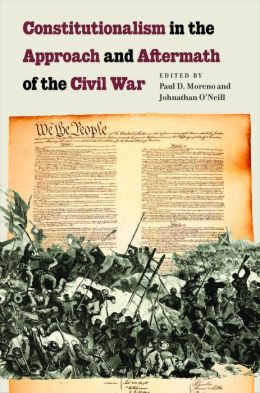
New Release: "Constitutionalism in the Approach and Aftermath of the Civil War"

New from Fordham University Press: Constitutionalism in the Approach and Aftermath of the Civil War, edited by Paul D. Moreno (Hillsdale College) and Johnathan O'Neill (Georgia Southern University). The Press describes the book as follows:
The irreducibly constitutional nature of the Civil War’s prelude and legacy is the focus of this absorbing collection of nine essays by a diversity of political theorists and historians. The contributors examine key constitutional developments leading up to the war, the crucial role of Abraham Lincoln’s statesmanship, and how the constitutional aspects of the war and Reconstruction endured in the late nineteenth and early twentieth centuries. This thoughtful, informative volume covers a wide range of topics: from George Washington’s conception of the Union and his fears for its future to Martin Van Buren’s state-centered, anti-secessionist federalism; from Lincoln’s approach to citizenship for African Americans to Woodrow Wilson’s attempt to appropriate Lincoln for the goals of Progressivism. Each essay zeroes in on the constitutional causes or consequences of the war and emphasizes how constitutional principles shape political activity. Accordingly, important figures, disputes, and judicial decisions are placed within the broader context of the constitutional system to explain how ideas and institutions, independently and in dialogue with the courts, have oriented political action and shaped events over time.
More information is available here.

Wednesday, September 18, 2013

New Release: Flaherty, "Public Law, Private Practice: Politics, Profit, and the Legal Profession in Nineteenth-Century Japan"

The Harvard University Asia Center has released Public Law, Private Practice: Politics, Profit, and the Legal Profession in Nineteenth-Century Japan (2013), by Darryl E. Flaherty (University of Delaware). A description from the publisher:
Long ignored by historians and repudiated in their time, practitioners of private law opened the way toward Japan’s legal modernity. From the seventeenth to the turn of the twentieth century, lawyers and their predecessors changed society in ways that first samurai and then the state could not. During the Edo period (1600–1868), they worked from the shadows to bend the shogun’s law to suit the market needs of merchants and the justice concerns of peasants. Over the course of the nineteenth century, legal practitioners changed law from a tool for rule into a new epistemology and laid the foundation for parliamentary politics during the Meiji era (1868–1912).

This social and political history argues that legal modernity sprouted from indigenous roots and helped delineate a budding nation’s public and private spheres. Tracing the transition of law regimes from Edo to Meiji, Darryl E. Flaherty shows how the legal profession emerged as a force for change in modern Japan and highlights its lasting contributions in founding private universities, political parties, and a national association of lawyers that contributed to legal reform during the twentieth century.

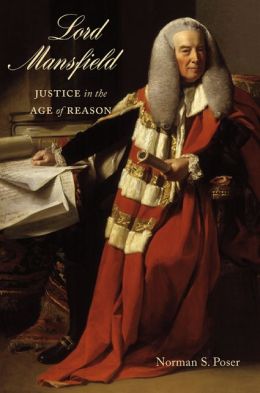
New Release: Poser, "Lord Mansfield: Justice in the Age of Reason"

New from McGill-Queen's University Press: Norman S. Poser, Lord Mansfield: Justice in the Age of Reason (2013). Poser is professor emeritus at Brooklyn Law School. A description from the publisher:
In the first modern biography of Lord Mansfield (1705-1793), Norman Poser details the turbulent political life of eighteenth-century Britain's most powerful judge, serving as chief justice for an unprecedented thirty-two years. His legal decisions launched England on the path to abolishing slavery and the slave trade, modernized commercial law in ways that helped establish Britain as the world's leading industrial and trading nation, and his vigorous opposition to the American colonists stoked Revolutionary fires. Although his father and brother were Jacobite rebels loyal to the deposed King James II, Mansfield was able to rise through English society to become a member of its ruling aristocracy and a confidential advisor to two kings. Poser sets Mansfield's rulings in historical context while delving into Mansfield's circle, which included poets (Alexander Pope described him as "his country's pride"), artists, actors, clergymen, noblemen and women, and politicians. Still celebrated for his application of common sense and moral values to the formal and complicated English common law system, Mansfield brought a practical and humanistic approach to the law. His decisions continue to influence the legal systems of Canada, Britain, and the United States to an extent unmatched by any judge of the past. An illuminating account of one of the greatest legal minds, Lord Mansfield presents a vibrant look at Britain's Age of Reason through one of its central figures.
A few blurbs:
"I read this book with much pleasure and instruction. It admirably fills a major gap in the body of legal historical literature - the absence of a comprehensive biography of arguably the most famous and influential Anglo-American judge of the modern era." -- Simon Devereaux

"A remarkable portrait of both a man and a legal age. I enjoyed the book tremendously, learned so much, and am deeply grateful. A master work." -- Kent Syverud