Showing posts with label Courts and judges. Show all posts

Thursday, September 26, 2013

July 2013 Issue of Journal of Supreme Court History

A new issue of the Journal of Supreme Court History is out. Here's the table of contents:
Introduction
Melvin I. Urofsky 
Slouching Towards Roth: Obscenity and the Supreme Court, 1945-1957
Whitney Strub

Tom Clark under Fire:  The Consequences of Congressional Investigations of Supreme Court Justices
Craig Alan Smith

Tom Clark’s Transition from Attorney General to Supreme Court Justice
Alexander Wohl

October Term 1963: “The Second American Constitutional Convention”
L.A. Powe, Jr.

Inventing Democratic Courts: A New and Iconic Supreme Court
Judith Resnik and Dennis Curtis

Addenda to “Fair Labor:  The Remarkable Life and Legal Career of Bessie Margolin”:  A Discussion of Methodology on Tallying Margolin’s Supreme Court Argument Record as Well as Those of Other Pioneer Female Advocates Mabel W. Willebrandt, Helen R. Carloss and Beatrice Rosenberg
Marlene Trestman

The Judicial Bookshelf
Donald Grier Stephenson Jr.
Hat tip: H-Law

Tuesday, September 24, 2013

McSweeney on Civil and Common Law in Medieval England

Thomas J. McSweeney, William & Mary Law School, has posted two articles.  The first is Property Before Property: Romanizing the English Law of Land, which appeared in the Buffalo Law Review 60 (2012):
We tend to treat the idea of property as if it is a neutral way to speak about the relationship between people and things. In comparative legal studies, it is easier to compare two different cultures’ approaches to people and things when we assume that both can usefully be spoken of in terms of property. But property has a history. Terms like proprietas and possessio, which give the modern common law a vocabulary for speaking about that relationship, arose in the context of the classical Roman law and were worked into a systematic language of property by medieval Roman law scholars. The early common law, however, did not use the language of property to describe the relationship between people and things.
Image Credit: BC Law Library
In this paper, I will examine the period when English justices first attempted to turn English norms and practices concerning landholding into a law of property. Between 1187 and 1258, several justices tried their hands at writing treatises in which they translated English court practices into a systematic property law on the Roman model. The justices of the twelfth and thirteenth centuries, particularly the justices who wrote the treatise known as Bracton, were heavily invested in the idea that English law was part of the Romano-canonical ius commune. They realized, however, that the practices of the English courts and the landholding norms of the Anglo-Norman landed elite could not be made to fit neatly into a Roman law mold. The authors of Bracton embarked upon what we might consider an early exercise in comparative law scholarship. They created several complicated and contradictory schemes to try to express English landholding in Roman law terms, but ultimately failed in their attempts to create a coherent English law of property. Their failure is useful to us, however, in that it shows us very clearly that the language of property is not natural or essential and in that it helps us to understand a way of talking and thinking about landholding that is alien to us today. We can use the ways the Bracton authors creatively misunderstood the Roman law of property to help us to understand the cultures of landholding they came from: those of the English courts and the Anglo-Norman landed elite of the twelfth and thirteenth centuries.
The second is English Judges and Roman Jurists: The Civilian Learning Behind England's First Case Law, which appeared in Temple Law Review 84 (2012):
This Article looks at a historical problem — the first use of case law by English royal justices in the thirteenth century — and makes it a starting point for thinking about the ways legal reasoning works in the modern common law. In the first Part of the Article, I show that, at its origin, the English justices’ use of decided cases as a source of law was inspired by the work civil and canon law scholars were doing with written authorities in the medieval universities. In an attempt to make the case that English law was on par with civil law and canon law, the justices and clerks of the royal courts began to treat cases as if they were the opinions of great jurists, to apply the same types of dialectical reasoning that were used in civil law discourse to those cases, and to work them into systems of authority. They used cases, as the modern common law does; but they used cases to create systems of the kind we usually associate with civil law. In the second Part of the Article, I turn to the modern common law and, using the methods of medieval case law as a mirror, show that the differences between civil law and common law reasoning are more perceived than real. American lawyers tend to view common law as flexible and creative, whereas they view civil law as ossified and hierarchical. This largely stems from the fact that common lawyers focus on the judicial opinion as the place where legal reasoning takes place. By integrating other texts, like the student outline and the restatement — which seek to create a harmonious system out of judicial opinions — into the picture of common law reasoning, I show that common law reasoning shares quite a bit in common with civil law reasoning.

Friday, September 20, 2013

Novick on Holmes and the New Originalists

Sheldon Novick, Vermont Law School, has posted a new preface, entitled Honorable Justice at Twenty-Five, to his biography Honorable Justice: The Life of Oliver Wendell Holmes (1989).  Here is the abstract:
There have been three print editions since 1989 of Honorable Justice: The Life of Oliver Wendell Holmes by Sheldon Novick: the first hardcover edition from Little Brown, a trade paperback edition from Dell Publishing, and a collectible leather-bound edition from Legal Classics Library. The text of successive print editions was unchanged. A new ebook edition from Plunkett Lake Press has been revised and corrected, redesigned for digital readers, and a new preface has been added bringing the book up to date. This article includes the text of the preface.

In summary: Interest in Justice Holmes continues, especially with regard to his First Amendment jurisprudence. He has also become a major figure in debates over originalism. As portrayed in this biography, Holmes was a champion of the common law, particularly as common-law privileges were the basis of the Bill of Rights. He viewed the Supreme Court as a common-law court bound by its precedents, and engaged in the process of defining the principles "transplanted from foreign soil" found in those precedents The New Originalists argue that the original understanding of the text of the Constitution is authoritative in cases arising under the Constitution, and that fidelity to the original understanding trumps any precedents that depart from it. Holmes, the champion of an evolving common law, accordingly has become the target of originalist criticism, criticism that the author of this preface claims he stoutly withstands.

Thursday, September 19, 2013

Cushman on "Court-Packing and Compromise"

Senate Judiciary Committee Considers the Court-Packing Bill (Credit: LC)
Barry Cushman, Notre Dame Law School, has posted Court-Packing and Compromise, which appears in Constitutional Commentary 26 (2013).  Here is the abstract:
President Franklin D. Roosevelt’s 1937 Court-packing bill would have permitted him to appoint six additional justices to the Supreme Court, thereby expanding its membership to fifteen immediately. Throughout the ultimately unsuccessful campaign to enact the measure, Roosevelt was presented with numerous opportunities to compromise for a measure authorizing the appointment of fewer additional justices. The President rejected each of these proposals, and his refusal to compromise often has been attributed to stubbornness, overconfidence, or hubris. Yet an examination of the papers of Attorney General Homer S. Cummings reveals why FDR and his advisors believed that he required no fewer than six additional appointments in order to secure a liberal working majority on the Court. Those sources also help to clarify why the substitute Court bill introduced by Senate Majority Leader Joseph Robinson in July of 1937 took the form that it did, and why Robinson’s untimely death that month not only made passage of the bill impossible, but also made it unnecessary. Though Roosevelt’s refusal to compromise can be seen as more rational than is commonly thought, in retrospect one can see that his Court-packing proposal was an entirely unnecessary misadventure through which the President ultimately lost far more than he gained.
Update
I can't resist the temptation to chime in with something I've just read in the archives.  On November 4, 1936, Charles E. Wyzanski, Jr., wrote his mother from the Solicitor General's office: “I do not like the size of the Roosevelt vote.  With a man of the President’s temperament such an endorsement may prove an irresistible temptation."  DRE.

Wednesday, September 18, 2013

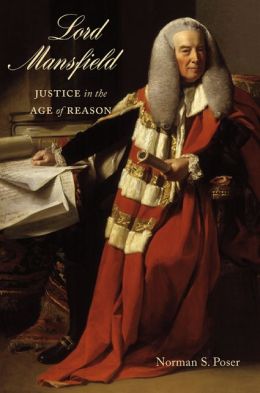
New Release: Poser, "Lord Mansfield: Justice in the Age of Reason"

New from McGill-Queen's University Press: Norman S. Poser, Lord Mansfield: Justice in the Age of Reason (2013). Poser is professor emeritus at Brooklyn Law School. A description from the publisher:
In the first modern biography of Lord Mansfield (1705-1793), Norman Poser details the turbulent political life of eighteenth-century Britain's most powerful judge, serving as chief justice for an unprecedented thirty-two years. His legal decisions launched England on the path to abolishing slavery and the slave trade, modernized commercial law in ways that helped establish Britain as the world's leading industrial and trading nation, and his vigorous opposition to the American colonists stoked Revolutionary fires. Although his father and brother were Jacobite rebels loyal to the deposed King James II, Mansfield was able to rise through English society to become a member of its ruling aristocracy and a confidential advisor to two kings. Poser sets Mansfield's rulings in historical context while delving into Mansfield's circle, which included poets (Alexander Pope described him as "his country's pride"), artists, actors, clergymen, noblemen and women, and politicians. Still celebrated for his application of common sense and moral values to the formal and complicated English common law system, Mansfield brought a practical and humanistic approach to the law. His decisions continue to influence the legal systems of Canada, Britain, and the United States to an extent unmatched by any judge of the past. An illuminating account of one of the greatest legal minds, Lord Mansfield presents a vibrant look at Britain's Age of Reason through one of its central figures.
A few blurbs:
"I read this book with much pleasure and instruction. It admirably fills a major gap in the body of legal historical literature - the absence of a comprehensive biography of arguably the most famous and influential Anglo-American judge of the modern era." -- Simon Devereaux

"A remarkable portrait of both a man and a legal age. I enjoyed the book tremendously, learned so much, and am deeply grateful. A master work." -- Kent Syverud